
‘Very Complete, Pretty Much’
Trump describes the bombing of Iran like a project finished ahead of schedule. Meanwhile, hospitals collapse, families flee and a war unfolds far from the language used to describe it.

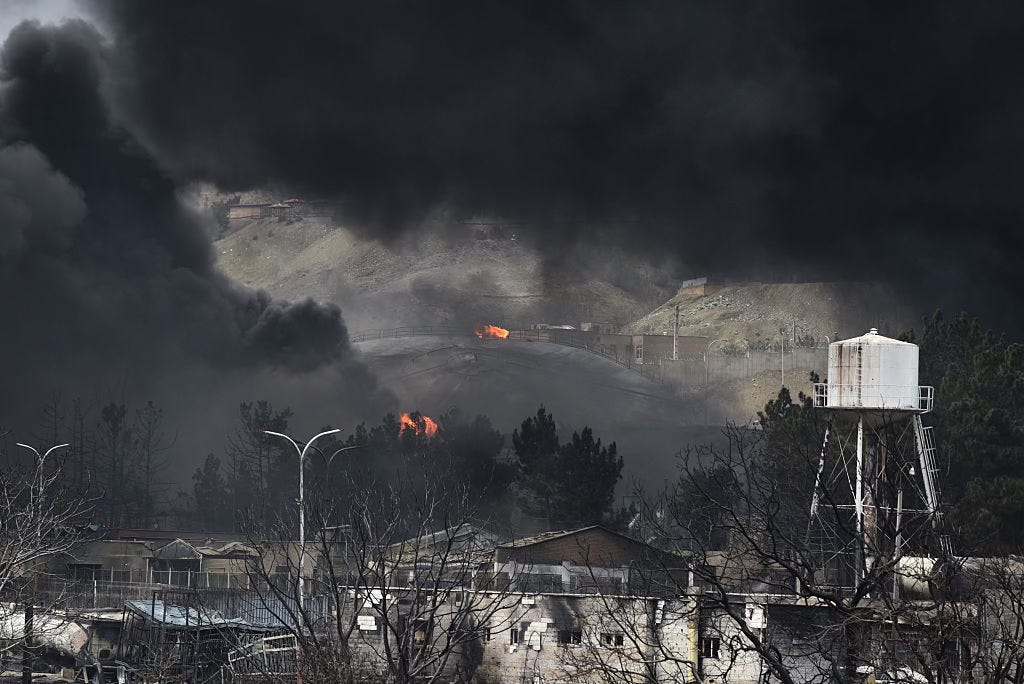
On Monday, the president said his blizzard of a war in Iran was “very complete, pretty much.”
He said the U.S. was “very far ahead of schedule.”
He said Iran had “no navy, no communications, no Air Force.”
He said the conflict would be over “very soon.”
Words delivered with a half‑smile and a shrug, as if he were briefing a project team instead of describing the bombardment of a nation.
“Very complete.”
“Very soon.”
Meanwhile, behind Trump’s tornado of terse sentences, more than 1,200 civilians have been killed, including hundreds of children, as infrastructure crumbles under U.S.-Israeli strikes, according to news reports. Hospitals have been damaged; ambulances and emergency centers destroyed. A toxic cloud from targeted oil depots blots out the sky over Tehran. Nearly 100,000 people are estimated to have fled the capital alone, and those numbers don’t account for untracked movements in the days since communications blackouts began.
Across the region, the number of people forced from their homes is astronomical — nearly 700,000 in Lebanon alone.
War, in Trump’s words, sounds like a deadline, a task completed ahead of schedule, rather than a human tragedy with no finish line.
He said Iran’s defenses are decimated.
He said the campaign has crippled military infrastructure.
He predicted the end would come soon.
Spectacular. Decimated. Obliterated. Ahead of schedule.
These are words of triumph, of military might neatly tallied on a spreadsheet. But the human toll is measured in ways that resist such accounting.
A child crying under newly screaming skies.
A school standing in ghostly stillness where a strike once hit — a grim echo more lasting than any speech.
Families walking away from houses that may never be homes again, dragging children past rubble and dust and carrying a heap of unanswerable questions.
Displacement is not a number; it is the hollow ache in a child’s stomach when there is not enough bread.
The World Health Organization has warned of grave public health risks as clinics shut down, emergency centers close and essential medical services crumble under continued bombardment.
A legion of ambulances lies wrecked, paramedics among the injured.
The president’s words may be light, but his tone is barbed.
“Very complete.”
“Very soon.”
That casualness — the ease with which such devastation is narrated — tells a story of its own. Language is not incidental in conflict. It is the lens through which a country tries to understand its own power: what a nation chooses to celebrate and what it chooses to muddy in the fog of war.
When war begins to sound like a finished project rather than an unfolding catastrophe, the country doing the describing starts to sound less like a nation wrestling with its own power and more like one congratulating itself on how efficiently it can wield it.
“Very complete, pretty much.”
A war isn’t over because someone says it is. But the way it’s described can make it sound that way.
Just as language can show an emotion or sensitivity, so can clothing. Trump's choice of a baseball hat and a red tie to bear witness to the dignified transfer of caskets was like screaming from the rooftops, "I REALLY DON'T CARE"! And he doesn't. This is like a video game to him, all while he is filling his pockets.
It is quite evident that there was no plan of how to manage this wrong and illegal war. We have heard numerous reasons for invading Iran, none of which can be justified. But to me, the most upsetting is the lack of empathy for the death of innocent people and especially the “accidental” bombing of that girls school. In fact the rhetoric from Trump, Vance and Hesbeth seems to be overflowing with glee and excitement for the daily destruction.