
They Controlled the Force. They Didn’t Control the Record.
From Minneapolis to Washington, officials rushed to shape the narrative — and ran into cameras, witnesses and a record they couldn’t restrict.

Journalism is too opaque and misunderstood. Chills gives a behind-the-scenes look at how dangerous investigative journalism gets made.
In an ongoing propaganda campaign, federal officials framed the Jan. 7 shooting of Renee Good in Minneapolis as self-defense, a claim that traveled quickly through official channels. Video and eyewitness accounts, however, suggested a very different sequence — a slow-moving car, shots fired, and immediate public outrage. Minneapolis Mayor Jacob Frey publicly rejected the federal account as “bullshit,” a blunt acknowledgment of the widening gap between institutional assertion and observable reality.
The scene outside the city’s Whipple Federal Building the next day was electric, tense and cold. Protesters in parkas held signs, voices rising in anger, while photojournalists crouched at angles to capture the movement of bodies and cars, the winter light rebounding off concrete and glass. Every frame and note the press corps detailed mattered. This was record-making that officials could not dictate: a parallel evidentiary track that resisted the speed and authority of a prepackaged self-defense narrative.
That work carried particular urgency because federal authorities reportedly quickly restricted state investigators’ access to evidence. When formal oversight is narrowed, public documentation is no longer supplementary; it becomes one of the few remaining mechanisms through which claims can be tested against reality.
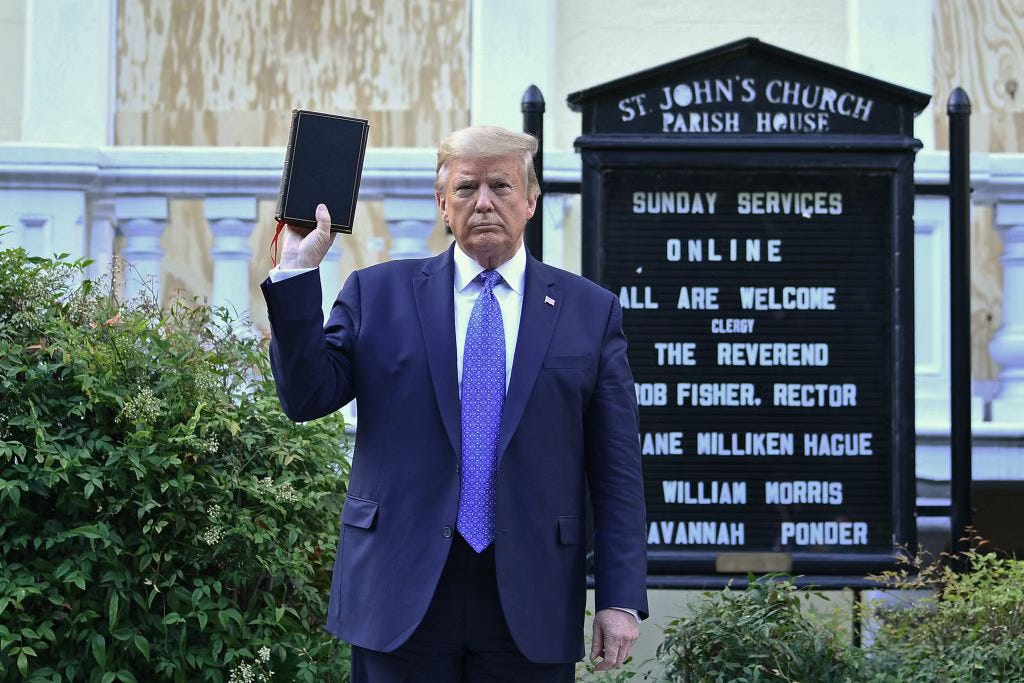
The struggle between official framing and lived fact has been a recurring feature of the Trump era. On June 1, 2020, at Lafayette Square in Washington, federal agents cleared peaceful Black Lives Matter demonstrators with chemical agents, flash bombs, rubber bullets and sound cannons minutes before President Donald Trump’s Bible-holding photo op at St. John’s Episcopal Church. As the ACLU later noted, Trump did not appear for another half hour after the “clearing out” began. The demonstrators had posed no threat. The violence was initiated by federal officers.
Administration explanations shifted — curfew enforcement, perimeter expansion — but journalists documented the assault as it unfolded. Smoke hung in the late afternoon light. Protesters shielded their eyes. Cameras stayed fixated on the scene. That documentation constrained later reinterpretation, preventing the episode from being reduced to a simple assertion that the violence was about restoring order. What might otherwise have been absorbed as spectacle was instead preserved as a sequence, as cause and effect.
Historical precedent underscores how power and memory collide at moments of mass dissent. On Feb. 15, 2003, millions around the world protested the impending invasion of Iraq. I remember walking among hundreds of thousands in New York City, struck by the scale and coordination of opposition. The war went forward, but coverage ensured that dissent — its size, seriousness and urgency — remained part of the historical record rather than a footnote erased by policy outcomes.
Protests are fleeting by nature; journalism gives them duration. Officials often respond to dissent by emphasizing threat, disorder or optics, especially in the immediate aftermath, when attention is high and facts are still unsettled. Documentation disrupts that advantage. The public record remains contested, but it becomes harder to collapse into a single, convenient storyline.
In Minneapolis and Washington alike, authorities attempted to reshape reality. Government framing emphasized danger. Trump’s team foregrounded performance, treating the exertion of force as a visual demonstration of authority rather than an action requiring explanation or justification. Access was limited. Protesters and journalists together made events observable, verifiable and resistant to simplification.
Unfortunately, in the digital age, manipulated images and selective clips can circulate faster than verification. Protest combined with journalism creates a more robust record — one that captures context, sequence and consequence, challenging official framing not with counter-slogans but with evidence. Protest signals dissent; reporting anchors it in facts. Together, they make truth durable.
When authority treats facts as negotiable, visible and verifiable public resistance limits how easily reality can be rewritten.
Chills is self-funded, without ads. If you want to be a part of this effort, of revealing how difficult reporting is made — of sending me to places like Ukraine to report for you — I hope you will consider subscribing for $60/year or $6/month.
They believe if they can get the first word out, it will become true. Unfortunately for them, people saw with their own eyes what was true.
This is exactly why independent journalism matters right now. Your point about how "protest signals dissent; reporting anchors it in facts" really captures why documentation cant be dismissed as just media bias. I keep thinking about how many events would have been completley rewritten if cameras weren't there. Thank you for making the invisible work of journalism visible.