
The Digital Pimp
The alleged trafficking operation behind Washington’s “OnlyFans house” borrowed its playbook from influencer culture, Andrew Tate and the internet’s economy of misogyny.

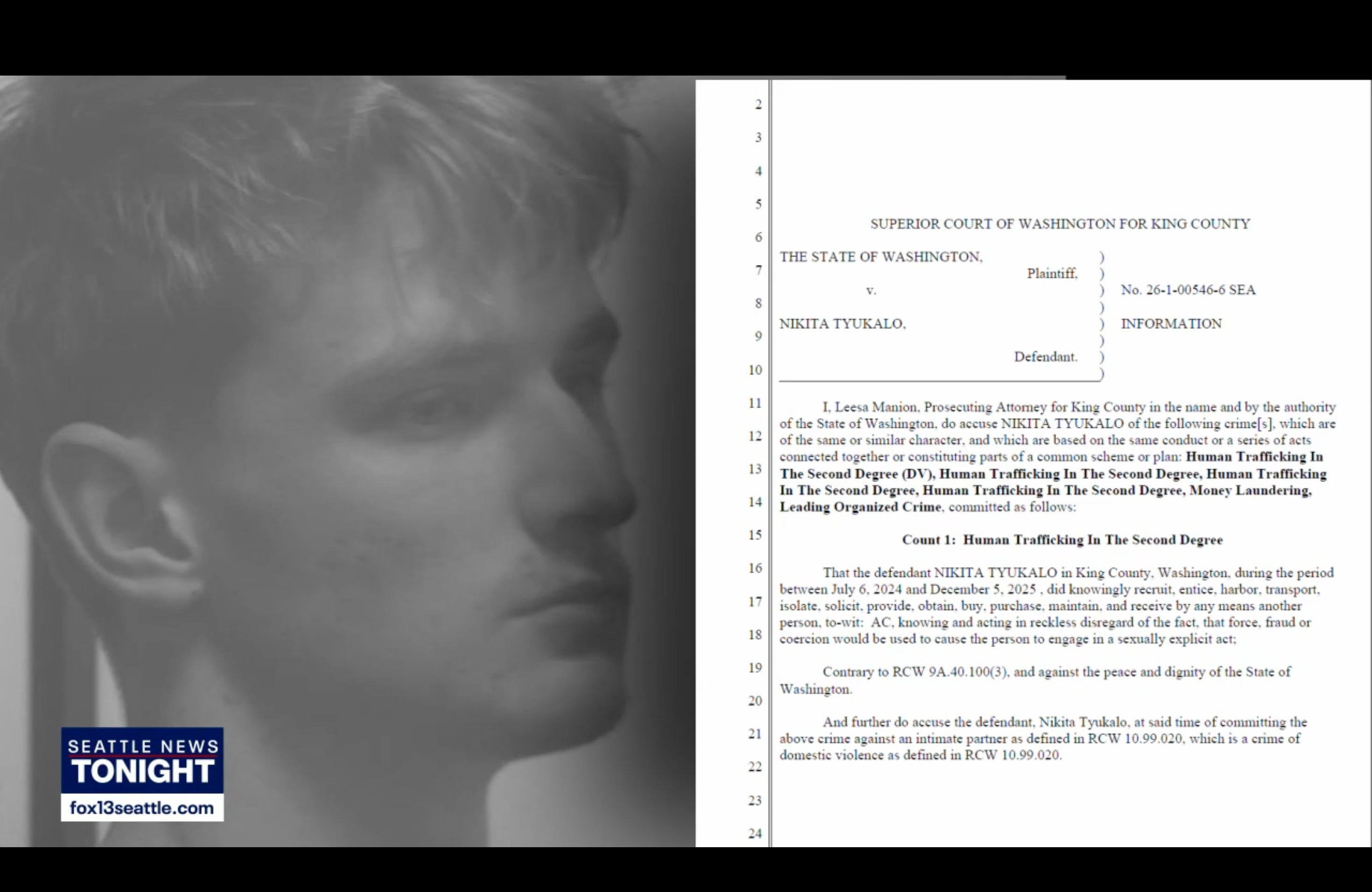
By January, the neighbors on Southeast 44th Place, a quiet cul-de-sac in Bellevue, Wash., were growing restless. Since the year began, they’d been calling 911, complaining about a rental house in Bellevue’s Lakemont neighborhood that had become, as referred to by the people who lived there, the “OnlyFans house.” Its parties were something out of an early 2000s teen movie and could be heard from blocks away as hundreds of attendees, many of them high schoolers, swarmed the home.
By the time the Bellevue PD recorded more than 100 complaints, they began to develop a theory that something beyond parties must be happening inside this Bellevue house. Last month, the theory led to a court date.
On June 8, 21-year-old Nikita Tyukalo was charged with human trafficking, money laundering and leading organized crime. The arrest was the result of a SWAT raid that uncovered, among other things, a McLaren, 300 cellphones and more than 50 laptops, according to charging documents filed in King County Superior Court. Prosecutors detail an abusive system of control concealed beneath a veneer of party mansions scattered across the Seattle area, luxury cars and adult content.
I started this piece as an investigation into a local crime. I was curious how someone around my age, from similar social circles, growing up just miles away from me ended up charged with running a multimillion-dollar sex-trafficking operation. What I found instead was a man deeply embedded in a lifestyle almost every teenager on the internet has seen — and which has quietly ensnared young women and girls into a sexualized trap that is entirely dependent on the rules set by men and boys.
Tyukalo’s Instagram page was predictable. Reposted clips of Andrew Tate ranking women’s attractiveness based on professions. Clips of Elon Musk and Jeff Bezos talking about wealth and family. Dozens of posts featuring stacks of cash, fancy cars, steak dinners and models in bikinis. His followers posted the same things, luxury displayed under Instagram bios promising money: “From dead end jobs to financial freedom. “DM to get rich.” The bios advertise services, day-trading mentorship, Polymarket picks and, for men like Tyukalo, the management of OnlyFans girls.
To Soraya Chemaly, a journalist and author who writes about the dynamics of patriarchy and feminism — her latest book is All We Want Is Everything — the mechanics described in the charges are recognizable.
“Traffickers use the same mechanisms, the same psychological messaging and alienation from women’s humanity when they groom people,” she told me. The mechanisms she means are the manosphere’s, whose ideologies, she said, “basically are factories of dehumanization.”
Tyukalo told one alleged victim that he ran OnlyFans accounts “like an agency,” boasting that he had changed entire lives — by which he meant male lives — citing private jets and large paychecks as evidence. It is the same type of pitch that has built online fortunes in various arenas over the last decade. The promise is this: Proximity to a man with money is itself a form of opportunity; the relationship is the product.
“I think the elephant in the room is clearly Andrew Tate,” Chemaly said, naming the man who popularized the playbook. “What has happened is this normalization of misogyny, misogynistic abuse and sex trafficking.”
Tyukalo’s operation had a name and functioned under a kind of corporate structure. Two of the men involved had at different times run their own “management” companies before merging into a joint venture called Nova Talent Management. Nova recruited young women through direct messages on Snapchat by flashing advertising modeling work and a starting pay between $8,000 and $10,000 a month. One woman recalled being told the job would involve “bikini photos.” Another was promised a 70/30 split in her favor.
As the charges detail, none of these promises were kept. Women described being walked through account verification on OnlyFans, Chaturbate and other adult-content websites only to have passwords changed by the men running the operation almost immediately. From that point onward, several women said, they had no way of knowing how much money they were earning, let alone had access to the funds. The charges allege that the women were made to livestream sexually explicit content for 10 to 14 hours a day, seven days a week.
Chemaly resists the idea that walking through the recruitment door for these schemes requires naivety.
“Women, men, grow up in the systems we live in, and those systems are supremacist, they’re patriarchal,” she said.
For women without other avenues, modeling has always been a reasonable path. She points out that beauty pageants remain a leading source of educational scholarships for women in the United States.
“This correlation between modeling and sex trafficking, as we can tell from cases like the Epstein files, is a very strong and old one,” Chemaly said. “There’s really nothing new about that.”
What is new is the machinery: “You have the psychological grooming, you have the financial exploitation, you have the cultural messaging and you have the digital marketing tools that are available, and none of those could come together as powerfully as they can now.”
Chemaly calls the structure a “pincer strategy.” On one side, girls and women are groomed toward the supply. On the other, “there are just large parts of the internet where boys and men unfortunately have aggregated,” trading in “the kind of psychological dehumanization that enables them to treat trafficked women and girls and children not as human beings but as things that they can use and exploit and manipulate.”
The house parties in Lakemont were where the two sides of the pincer met, the audience and the recruits in the same room.
And now, while the operation is under indictment, the message remains. Men like Tyukalo do not need to win in court. They have already won the audience. When I started working on this piece, Tyukalo had a little under 5,000 Instagram followers. Today, he has 6,000. The indictment, it seems, has been good for business.
The account in its present state, it would seem, confirms this. The posts are gone. The cash, the cars, the sushi dinners, all deleted. A man facing $5 million dollars in bail, charged with human trafficking, money laundering and leading organized crime, has scrubbed his digital footprint clean. All the posts are wiped, except one.
What remains is a single Instagram story posted just a week ago: Tyukalo in an elevator, a woman facing him, her arms around his shoulders. His hand proprietarily gripping her behind.
 | A guest post by
|
When I was a kid, I loved watching pageants. It seemed innocent. Wow.