
Beyond Mistrust: Why Ebola Response Keeps Failing in Congo
Having reported in Congo for years, I know why communities resist Ebola responders — it’s a rational response to decades of exploitation and broken promises by foreign powers.

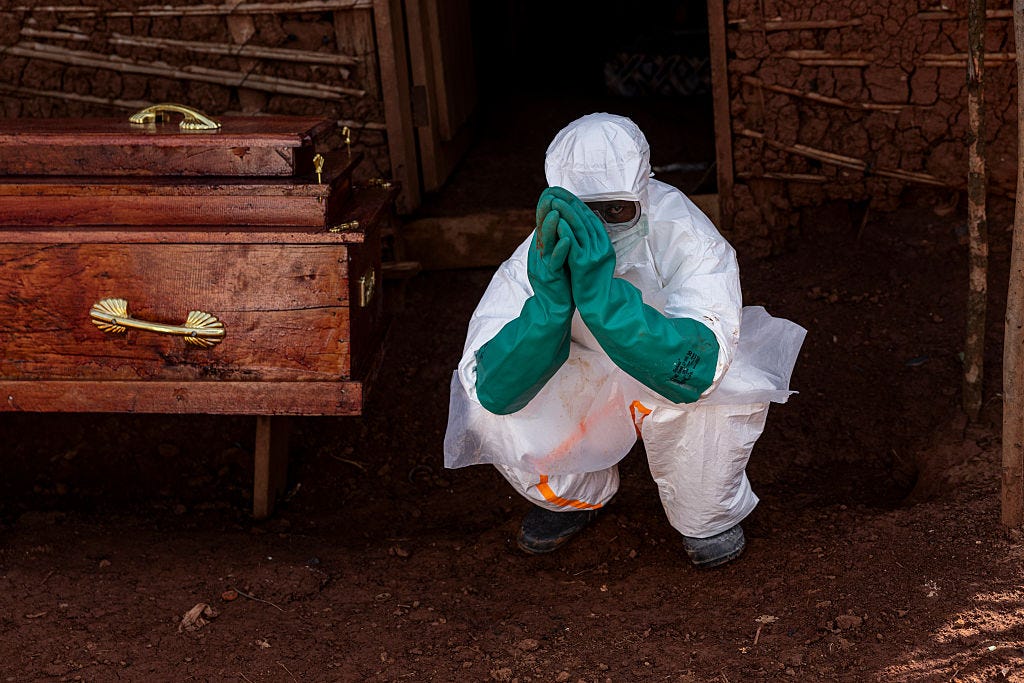
There is a heavy belief in witchcraft in the Democratic Republic of Congo. I even had a foreigner — a Swedish doctor — tell me that in her years of living there, she’d seen too many things she just couldn’t explain unless it was sorcery.
I learned a fair amount about local suspicion of black magic while on my reporting trips there. As I interviewed people about the extreme number of child abductions and rapes in a village called Kavumu, near the eastern city of Bukavu, I was told that there was a magic powder being sprinkled on houses (that were really shacks without doors) at night in order to keep everyone asleep while men abducted little girls.
This may have been true.
In the years since the men were convicted, I don’t believe anyone has determined whether there was a real powder being used, but it was proven at trial that a local witch doctor had advised the men to rape the girls because their virgin blood would make the men “impervious to bullets.”
Read a backstory of how I reported about all this for The Guardian and other outlets here.
So when I read this story about Ebola in DRC in The Washington Post today, much of the suspicion and skepticism made sense to me.
When you live in a culture where unseen powers can inflict suffering, the idea that outsiders with syringes might be deliberately spreading disease doesn’t sound paranoid — it sounds entirely plausible.
The ongoing Ebola outbreak in DRC has become far more than a public health crisis. It represents a devastating breakdown of trust that is actively hampering disease control efforts. This mistrust is manifesting in violent attacks on health care facilities, with communities believing medical workers are deliberately spreading the disease rather than treating it.
The roots of this suspicion run more deeply than a simple belief in black magic and ill will. Congo has endured decades of exploitation by foreign powers seeking to extract valuable minerals like cobalt, essential for modern technology. This historical context has sown fertile ground for conspiracy theories when international organizations suddenly mobilize resources to combat Ebola — while ignoring other dire health needs.
Funding patterns have inadvertently validated these suspicions. Western nations have dramatically reduced support for general health care and development programs across the region. Save the Children, the Post reports, can now finance only one-third of the 96 health clinics it previously supported. And when Ebola appears — yet again — significant international money flows in specifically for the response to the outbreak.
As Rose F. Tchwenko from Mercy Corps explained in the Post, this disparity sends a troubling message: “Now people will see that the money only comes when it is about our agenda — about not wanting Ebola to come to us.” Communities interpret this as evidence that Western countries care only about diseases that might spread to them, not about Congo’s significant daily health struggles with malaria, measles or malnutrition.
The human consequences are severe. Beyond a 50 percent chance of death, Ebola survivors face permanent social ostracism — losing jobs, being abandoned by families and experiencing ongoing stigma. Adam Vainqueur, who survived Ebola in 2018, told the Post how “People fear you, your family chase you away or avoid you, at the market, people run away when they see you.” This stigma can be fatal when it prevents people from seeking treatment.
Operational challenges compound the problem. Delays in diagnostic testing and gaps between official accounts and community observations fuel further distrust. Rumors circulate that doctors are “giving people Ebola with injections,” while families refuse to believe loved ones have contracted the disease.
Unfortunately, some communities have developed theories that nonprofit organizations deliberately bring Ebola to justify their presence and secure funding. In Goma, cynical residents tell aid workers: “There’s no epidemic, and it’s just NGOs trying to get money.”
The crisis extends beyond local communities to international relations. The Trump administration’s dismantling of pandemic response capabilities has made the United States an unreliable partner in global health emergencies, complicating coordination efforts.
Health care workers like Greg Ramm with Save the Children warn of long-term consequences.
“After this is over — because this will end — the spotlight goes away, the journalists go away, and the surge of aid goes away,” he said. “And children will return to dying of malnutrition and measles and malaria because the world will have stopped caring.”
Read the full Washington Post story here.
This piece answered so many questions I didn't even know to ask. People see what they see, trust who they trust, and are suspicious of the foreigner. And given the current state of who WE are, I don't blame them.
Well written Lauren. It's really hard to convey beliefs that stem from world views different than ours. This is especially difficult when past corruption and bad practice validate the beliefs. You conveyed them well.