
10 Ways Covering ICE Protests Has Changed Journalism Forever
Every notebook, camera and press badge can turn ordinary observation into exposure, changing the job of journalism in real time.

Journalism is too opaque and misunderstood. Chills gives a behind-the-scenes look at how dangerous investigative journalism gets made.
One of the most powerful voices I’ve ever heard belonged to a very ill woman named Alma. She was a Syrian rape and torture survivor who sought me out in order to tell her story from a Jordanian hospital — with her name and face attached to it, which would have been the first time in the war a woman had been so transparent.
As I interviewed her, I realized that showing her face and full name could put her — and her family in Syria — at risk. I had to decide whether to honor her wish for full transparency or place limits on how I presented her story, a choice that felt almost like betraying her courage. (You can read here about what decision I made and why.)
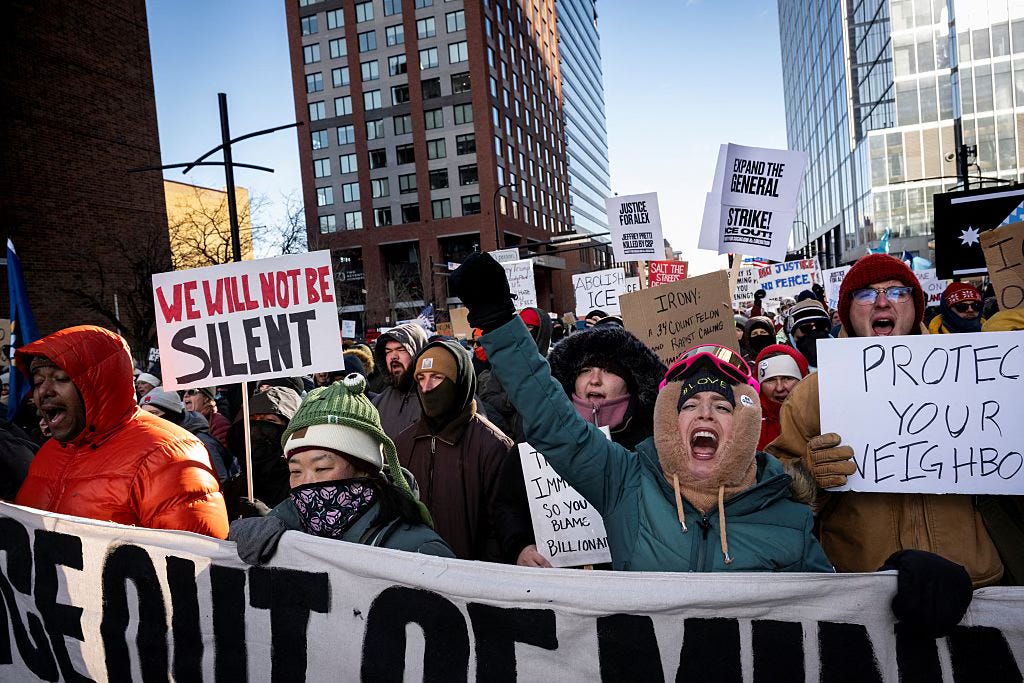
I’ve been thinking a lot recently about the jarring similarities between covering a war zone and Minneapolis, and other cities, where ICE is lawlessly arresting and killing people. There are ethical considerations journalists doing this work need to consider, perhaps in ways they’ve never had to before. Much of the precaution I’ve always taken in conflict areas around the world, I believe, applies here at home now.
With all the tools of government surveillance available, the attendees of ICE protests are vulnerable to tracking. But what we produce as journalists, too, can unwittingly be used by the government. With this in mind, we have a responsibility to protect people who never asked for us to photograph or write about them.
Covering ICE protests isn’t just documenting power — it’s negotiating proximity to it, where visibility can endanger those we aim to protect. The unsettling part: This isn’t a one-off distortion. It’s becoming standard operating procedure.
This isn’t about whether the protests are justified. It’s about what happens to the act of witnessing when the government treats public dissent as a data source.
Here are 10 ways the protests are shifting how we do our jobs as journalists:
1. Observation becomes intervention.
Notebooks, cameras and phones stop being neutral tools; capturing someone in real time can immediately expose them to danger, whether they consent or not.
2. Presence alone carries danger.
People standing nearby, watching, or passing through a protest can later be reinterpreted as participants or threats, making ordinary proximity risky.
3. Crowds are abstracted.
Law enforcement language flattens thousands of individual motives into “the protest,” treating people as a single system to manage rather than understand. Each protester has a story, even when law enforcement collapses them into a single, manageable unit.
4. Distance offers no protection.
Standing back as a journalist no longer guarantees safety or detachment when mere observation can be construed as involvement. (See: Don Lemon.)
5. Sources vanish behind anonymity.
Naming individuals can put them in jeopardy; ethical reporting increasingly requires withholding names not as a preference, but as harm reduction.
6. Our witnessing becomes self-limiting.
Anticipating misuse, journalists filter what we capture — skipping certain angles, details or moments of vulnerability not out of respect, but to reduce risk.
7. Credentials aren’t shields.
Press badges identify us, but they do not guarantee safety. Sometimes they make reporters more visible, and more vulnerable, to scrutiny, violence or detention.
8. Chaos overtakes context, but shouldn’t.
Explosions, arrests and shouting unfold faster than policy explanations or human stories, shaping coverage toward spectacle rather than nuance.
9. Our archive carries a latent threat.
Material recorded for accountability lingers, ready to be weaponized long after we’ve left the scene.
10. Ethics now include harm mitigation.
Beyond accuracy, journalists must anticipate downstream consequences — deciding what to publish, how to frame it and who could be exposed when it circulates.
I never imagined lessons from war zones would apply in the U.S., but here we are.
Chills is self-funded, without ads. If you want to be a part of this effort, of revealing how difficult reporting is made — of sending me to places like Ukraine to report for you — I hope you will consider subscribing for $60/year or $6/month.
Your equating true war zone situations with domestic protesting is quite chilling. It has always been understood that journalists covering a war zone is a dangerous and sometimes life threatening situation. The fact that said journalists must fear for not only themselves and those that they are trying to write and/or photo in this country is unimaginable. But, innocent, uninvolved bystanders are now being called terrorists as well as the actual peaceful demonstrators. Guilt by association has always been a tool used by autocratic and dictatorial nations. These are purely and simply gestapo tactics that would never before have been acceptable in any prior administration.
The one way identification process seems one of the most disturbing parts of the whole mess. That “law enforcement” personnel are incognito is anethema to what America is. What are they ashamed of?